SPOT Scene Graph
Release: 2026-10-06
- Modified on: 2026-10-06
- Revision:
- 1.0.0
- Issued on:
- 2026-10-06
- Authors:
- Oliver Schulz, Design Computation, RWTH Aachen University
- Imported Ontologies:
- gom
- <https://w3id.org/spot/>
- Extended Ontologies:
- https://w3id.org/spot/
- Download serialization:


- License:

- Cite as:
- Schulz, O. (2026, October 6). SPOT Scene Graph (Version 1.0.0) [Ontology]. Design Computation, RWTH Aachen University. https://w3id.org/spot/sg
Abstract
Extension of the Space Types Ontology (SPOT) for quantitative spatial descriptions. It aligns SPOT with the Geometry Metadata Ontology (GOM), so that spaces can be read as coordinate systems and appearances as transformations between them, forming a scene graph. This enables quantitative location descriptions: the position of a space within another space can be stated and computed numerically. It also adds a compact bounding box for spaces.Introduction back to ToC
The Space Types Ontology (SPOT) describes spaces and how entity spaces appear in reference spaces. SPOT-SG connects this structure to the Geometry Metadata Ontology (GOM): every SPOT Space is treated as a coordinate system and every SPOT Appearance as a coordinate system transformation, so that SPOT instance data can be read as a scene graph. In addition, SPOT-SG introduces a compact bounding box literal for spaces.
Namespace declarations
| spot-sg | <https://w3id.org/spot/sg#> |
| spot | <https://w3id.org/spot#> |
| gom | <https://w3id.org/gom#> |
| qudt | <http://qudt.org/schema/qudt/> |
| unit | <http://qudt.org/vocab/unit/> |
| owl | <http://www.w3.org/2002/07/owl#> |
| rdf | <http://www.w3.org/1999/02/22-rdf-syntax-ns#> |
| rdfs | <http://www.w3.org/2000/01/rdf-schema#> |
| xsd | <http://www.w3.org/2001/XMLSchema#> |
| dcterms | <http://purl.org/dc/terms/> |
| vann | <http://purl.org/vocab/vann/> |
| voaf | <http://purl.org/vocommons/voaf#> |
| schema | <http://schema.org/> |
SPOT-Scene Graph Extension: Overview back to ToC
This ontology has the following classes and properties.Classes
Object Properties
Data Properties
SPOT-SG Ontology: Description back to ToC
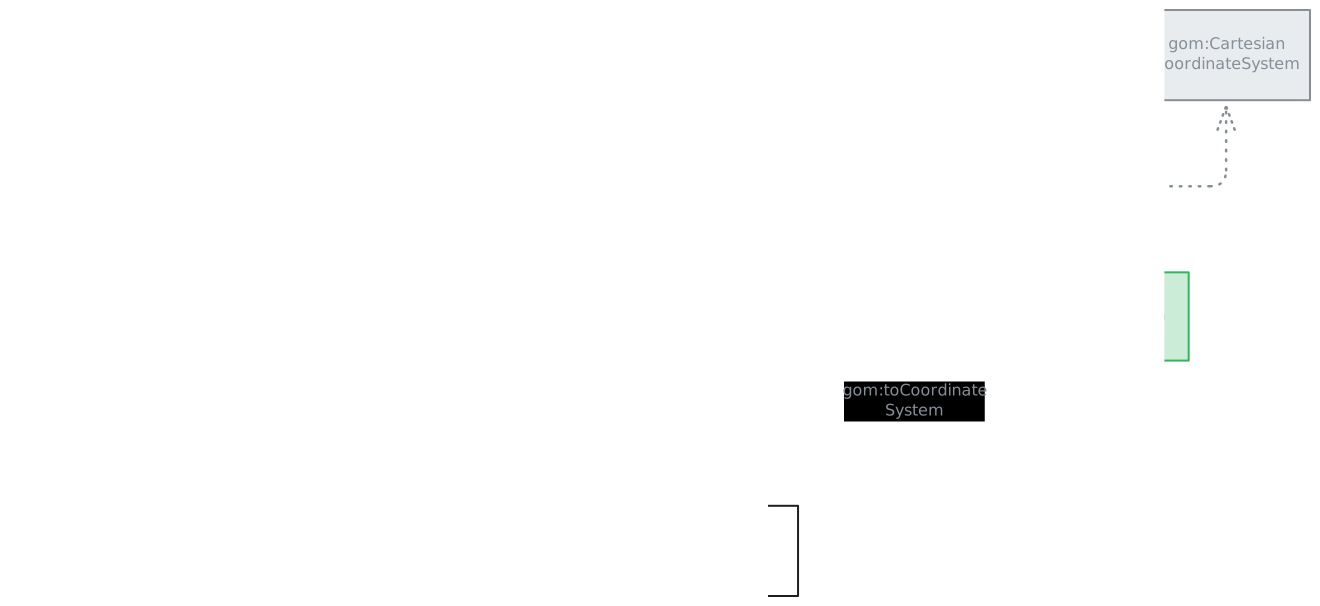
Spaces as coordinate systems
Every spot:Space is a gom:CartesianCoordinateSystem. Every Space instance (Physical or Virtual) defines a local coordinate system with an origin and axes. The Physical/Virtual distinction concerns real-world mappability (metric groundability), not the existence of a coordinate system. Two-dimensional spaces are treated as degenerate 3D spaces where the corresponding third axis exists but is constrained to zero. The alignment is declared on the abstract superclass spot:Space, so it covers the entire Space hierarchy.
Note on units: The length unit of a Space is declared with qudt:hasUnit, using units from the QUDT vocabulary such as unit:M or unit:PIXEL. Units without a fixed physical length, such as pixels, are adopted into the reference space at a ratio of 1:1; the actual ratio is carried by the transformation matrix of the Appearance. The same Space can therefore appear at different scales in different reference spaces. A unit MUST NOT be assumed when none is declared: GOM's default of metre does not hold for SPOT spaces, since DocumentSpaces may use pixel coordinates.
Appearances as coordinate system transformations
Every spot:Appearance is a gom:AffineCoordinateSystemTransformation. An Appearance describes how an EntitySpace is positioned within a reference space. This allows gom:fromCoordinateSystem, gom:toCoordinateSystem and gom:hasTransformationMatrix to apply directly to Appearance nodes. This holds for every Appearance regardless of the type of the reference space, so the alignment is declared on the abstract superclass spot:Appearance.
Property alignment
spot:appearsInis a subproperty ofgom:toCoordinateSystem.spot-sg:isAppearanceOfis the inverse ofspot:hasAppearanceand a subproperty ofgom:fromCoordinateSystem.
Together, a complete GOM transformation pattern is derivable from standard SPOT instance data. Only the transformation matrix itself has to be asserted. For the example in Figure 1, the asserted data is:
ex:Damage a spot:EntitySpace ;
    spot:hasAssetAppearance ex:DamageAppearance .

ex:DamageAppearance a spot:EntityAppearance ;
    spot:appearsIn ex:FloorPlan ;
    gom:hasTransformationMatrix "[1,0,0,0, 0,1,0,0, 0,0,1,0, 0.21,-0.65,0,1]"^^gom:columnMajorArray .

ex:FloorPlan a spot:EntitySpace .
From this, it may be inferred:
ex:Damage a gom:CartesianCoordinateSystem .
ex:FloorPlan a gom:CartesianCoordinateSystem .
ex:DamageAppearance a gom:AffineCoordinateSystemTransformation .

ex:Damage spot:hasAppearance ex:DamageAppearance .              # hasAssetAppearance is a subproperty
ex:DamageAppearance spot-sg:isAppearanceOf ex:Damage .          # inverse of hasAppearance
ex:DamageAppearance gom:fromCoordinateSystem ex:Damage .        # via isAppearanceOf
ex:DamageAppearance gom:toCoordinateSystem ex:FloorPlan .       # via appearsIn
Single-use Appearances
Each Appearance links exactly one source space to exactly one target space, as gom:fromCoordinateSystem and gom:toCoordinateSystem are functional properties. An Appearance must therefore not be shared by multiple spaces, even if their transformations are identical: a reasoner would otherwise infer that the spaces involved are identical (owl:sameAs). A space that appears in several places gets its own Appearance for each of them.
Bounding box
spot-sg:hasBoundingBox relates a Space to its bounding box in the Space's local coordinate system, encoded as a spot-sg:boundingBoxArray literal: an array with exactly six elements:
[minX, minY, minZ, maxX, maxY, maxZ]For a two-dimensional Space, the minimum and maximum value of one axis are set to 0. Which axis that is depends on the Space and is not restricted to Z.
Units are those of the Space's local coordinate system and are therefore heterogeneous across a dataset. Meaningful spatial comparison requires unit resolution and transformation matrix application on the client side.
Cross-reference for SPOT-Scene Graph Extension classes, object properties and data properties back to ToC
This section provides details for each class and property defined by SPOT-Scene Graph Extension.Classes
Appearancec back to ToC or Class ToC
IRI: https://w3id.org/spot#Appearance
- has super-classes
- Affine Coordinate System Transformation c
- is in domain of
- is appearance of op
Spacec back to ToC or Class ToC
IRI: https://w3id.org/spot#Space
- has super-classes
- Cartesian Coordinate System c
- is in domain of
- has bounding box dp
Object Properties
appears Inop back to ToC or Object Property ToC
IRI: https://w3id.org/spot#appearsIn
- has super-properties
- to Coordinate System op
is appearance ofop back to ToC or Object Property ToC
IRI: https://w3id.org/spot/sg#isAppearanceOf
- has super-properties
- from Coordinate System op
- has domain
- Appearance c
- has range
- Entity Space c
- is inverse of
- has Appearance op
Data Properties
has bounding boxdp back to ToC or Data Property ToC
IRI: https://w3id.org/spot/sg#hasBoundingBox
- has domain
- Space c
- has range
- bounding box array ep
Legend back to ToC
op: Object Properties
dp: Data Properties
ep: External Properties
Acknowledgments back to ToC
The authors would like to thank Silvio Peroni for developing LODE, a Live OWL Documentation Environment, which is used for representing the Cross Referencing Section of this document and Daniel Garijo for developing Widoco, the program used to create the template used in this documentation.